
Attack? Use the Red, Yellow or Green Light
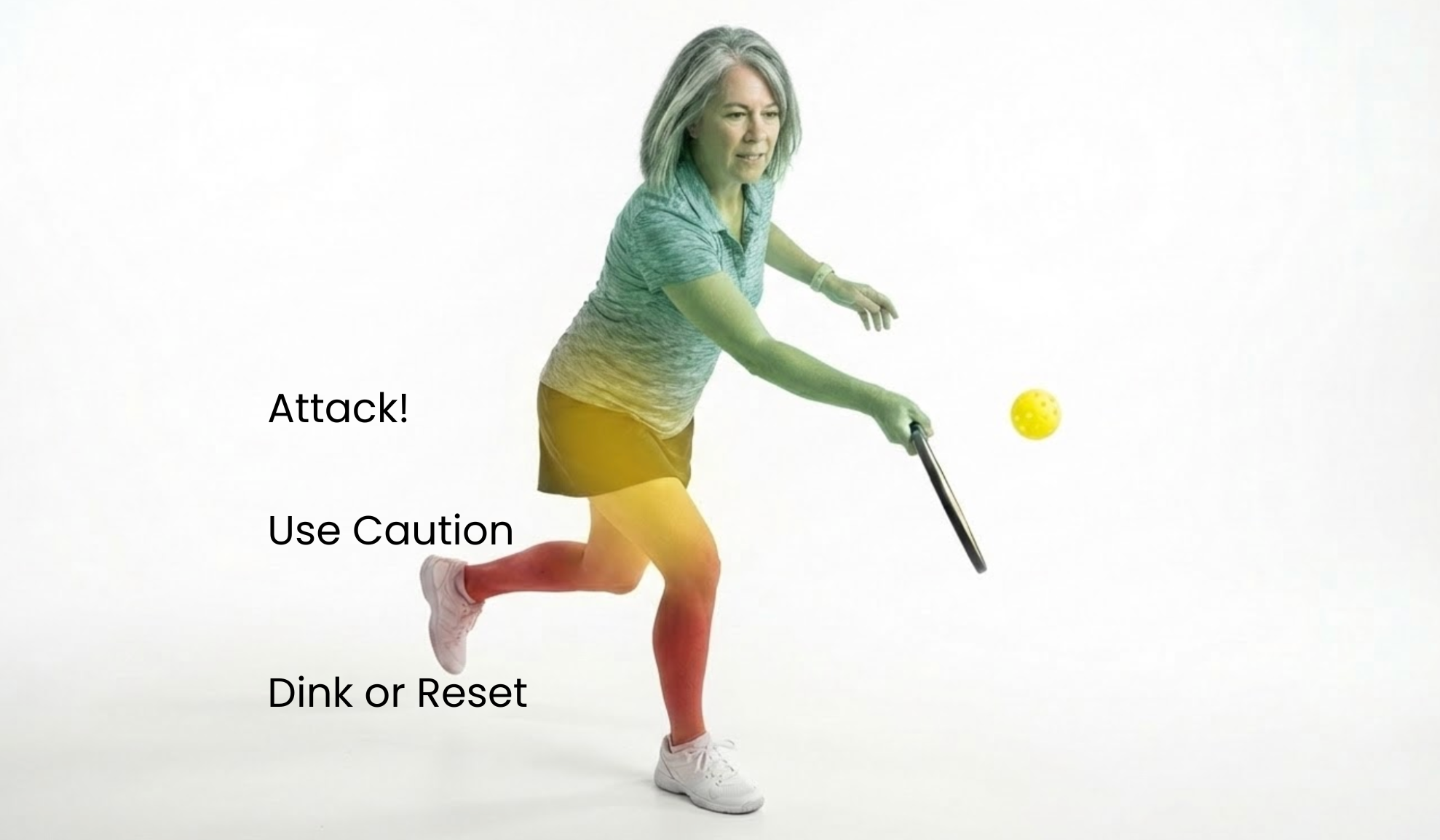
Think of the height of the ball like a traffic light when it comes to speeding up the ball. Its height tells you whether to slam on the brakes, cruise with care, or stomp the accelerator. Today I played against Amir. To him just about everything was a green light, and I knew that when I hit a nice low dink and he hit a speed up at me…it was going out.
Here’s how to use red/yellow/green to decide when to speed up the pace of the ball.
Red light — ball below the knees: don’t speed up
Low shots invite errors if you try to blast them. When the ball’s under knee height your priority is control: absorb pace with a compact block or drop it back in the kitchen with a soft, steady stroke. Attempting to speed up a low ball usually means slamming it into the net, giving your opponent a ball that easy to counter, or, like Amir, blasting long. Practice controlled low‑ball responses with a partner feed so your instinct is to steady, not swing.
Yellow light — ball between knees and hips: consider a measured increase
This mid‑zone is the chooser’s turf. You can sometimes add pace here, but only if the ball’s height, spin, and your balance line up. A medium‑height, slightly sped up shot is a good candidate for a controlled speed‑up: short, firm contact, keep the paddle face slightly closed, and drive the ball low over the net, at about 60% power. If the feed is fast or skidding, hold off, a panic swing turns a safe play into a mistake. Train with alternating feeds (slow then fast) so your eye and hands learn to judge when to accelerate.
Green light — ball at or above hips/top‑of‑net: punch it
High balls are your invitation to speed up. When the ball sits at hip or chest height you can take a compact swing and put serious pace and angle on it while still keeping it low over the net. Use leg drive and hip rotation, shorten the backswing, and aim to drive the ball down into the court. High returns let you hit with authority and punish lazy replies. Drill high‑ball drives and putaways until the motion is instinctive.
Practice tips to make the system work
Read early: start deciding before the ball reaches you. Early picks let your feet and shoulder prepare the correct stroke.
Keep swings compact: increasing pace is about timing and acceleration, not wild backswings.
Drills: mixed‑height feeds with a partner where you call “red/yellow/green” aloud and choose the correct response.
Final thought: speeding up the ball at the right moment turns defense into offense. Respect the red, pick smart in the yellow, and when you see green, hit it like you mean it. Your opponents will hate it, and your partner will love it.