
How to Get Better at Pickleball Without a Lesson, Drilling or a New Paddle
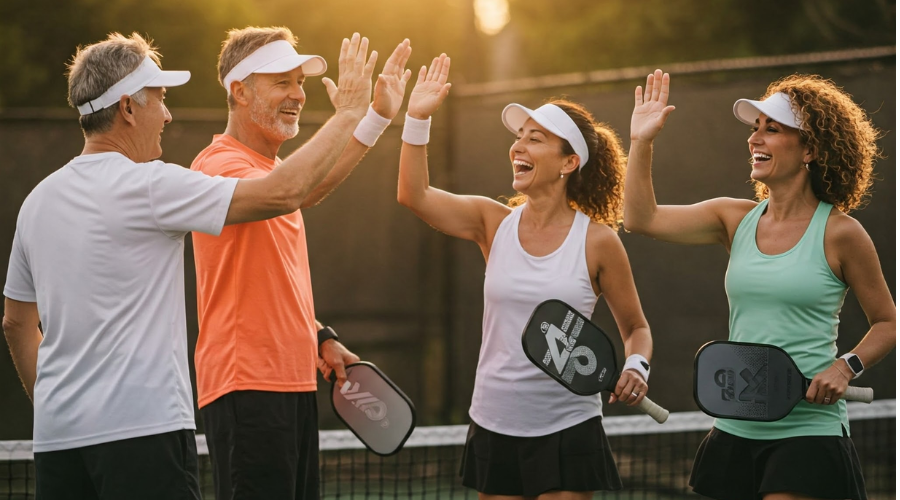
One of the sneaky best ways to improve at pickleball has nothing to do with drilling, lessons, or buying the hottest new paddle.
It’s playing pickleball on vacation.
Not because you suddenly become more athletic somewhere between the airport and the resort, or because sand in your shoes is that missing secret. But because travel quietly forces you out of your habits.
I’m writing this from lovely Rincon Puerto Rico and we’ve played a few times with the local crew. They are welcoming and friendly, but completely unknown. When playing Ryan and Ashley, we had no idea what their weaknesses were, or their strengths. We had to adapt quickly. And the courts here are waaaay different than home. They are painted concrete and slick and fast. For the first few games I missed more balls in one game than I do in three days of playing back home, and then I was hitting most balls off the bottom third of the paddle face. Talk about adjusting!
At home, most people play the same courts, with the same players, in the same conditions, every week. You learn everyone’s tendencies. You know Mike speeds up too often, Pat lobs on game point, and you know who insists the ball was out despite being 25 feet away and wearing transition lenses.
Vacation pickleball changes all of that.
Suddenly, you’re adapting.
New players force you to read the game differently. One group may dink patiently for twenty shots. Another may attack absolutely everything above shoelace height. Some regions play faster. Others play softer. Some players stack constantly. Others seem philosophically opposed to kitchen strategy altogether.
Learning to adjust in real time is a huge skill, and most recreational players don’t practice it enough.
Travel also exposes you to different court surfaces and conditions. Outdoor courts in Arizona play differently than humid Florida courts or courts in the thin air of Colorado. Some surfaces are fast. Some grip more. Some balls bounce high while others stay low and skid through.
Even lighting changes things. Indoor depth perception can throw players off for an entire session. Wind can humble people who think they have a great lob.
The players who improve fastest are usually the ones who stop fighting the conditions and start adapting to them.
Vacation play also tends to loosen people up mentally. At home, you can players become overly attached to results. You know should beat Bob and Carol and losing to them stings. On vacation, there’s often less pressure. You’re more willing to try a new shot, play with unfamiliar partners, or jump into a stronger game. It’s like a box of chocolates, you never know what you are going to get.
A player who spends four days adjusting to different opponents, speeds, weather conditions, and court surfaces is building versatility. And versatility is one of the clearest differences between average players and advanced ones.
There’s also something valuable about seeing how other communities play the game. You pick up little things: positioning habits, warm-up routines, communication styles, even smarter shot selection.
Not every improvement in pickleball comes from formal coaching. Sometimes improvement comes from exposure to different courts, different players and different rhythms. Plus, vacation pickleball players tend to be friendlier before 9 AM than almost any other group of humans on earth.
